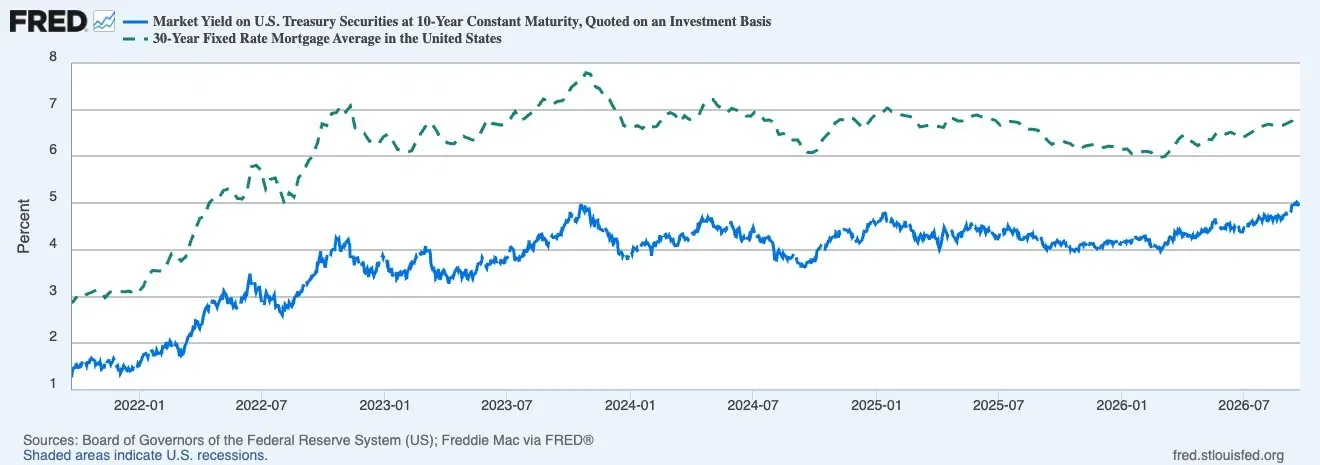
The yield on 10-year government bonds is at its highest level since 2007. US mortgages are back above 7%. What does this mean for stock markets?
The 10-year government bond yield jumped to 5.10%, the highest since 2007. The average 30-year mortgage in the US picked up on it right away and stands at 7.12%, the highest in more than two years. Ironically, the trigger was good news, specifically the PMI index.
PMI works as a survey of business sentiment. Every month, hundreds of purchasing managers are asked simple things: Are you ordering more or less? Are you hiring? Are your prices rising?
One number comes out of the answers:
XY > 50 = economy is growing
XY < 50 = economy is slowing
Why is it so important? Because it arrives before official statistics. GDP is released with a delay of several months, but managers see changes first. When companies stop ordering, it tends to be the first signal of a slowdown. And when they start raising prices, it usually soon shows up in overall inflation.
This time, PMI came in at 58.4 points, while the market expected 55. American businesses are growing at the fastest pace in five years. In the same survey, however, they admit that their costs are rising at the fastest rate in four years and that they are passing them on to prices without difficulty. For the Fed and the bond market, this second part is the key one.
And here is the main point. After the Fed raises rates, long-term yields usually stay calm because the market believes the central bank has inflation under control.
Now the opposite is happening. The short end of the curve is driven by the Fed, the long end by confidence, which is weakening.
Investors are demanding higher compensation for lending to the US government for many years. The economy is running at full capacity, deficits are huge, and inflation refuses to return to target. Mortgages are just the first place where people feel it. The 10-year yield is used to value companies, refinance debt, and make investment decisions. It is the cost of capital for the entire economy.
The market was hoping for a return of cheap money. This data does not support that. When a strong economy pushes yields up, the Fed has no room to back off.
Stocks are still holding gains and the AI narrative. But every decimal point on bonds raises the bar that stocks must clear. Once the risk-free yield seriously competes with stocks, capital will start to flow out.