


Software Companies Can’t Easily Replace

Software stocks have shed more than a quarter of their value this year amid concerns about artificial intelligence. Yet industry-specific systems that power courts, insurers, pharmaceutical research, warehouses and rental management continue to grow and retain their customers. Replacing them means years of work, data migration and operational risk. The key question is whether this barrier translates into recurring revenue and real cash.
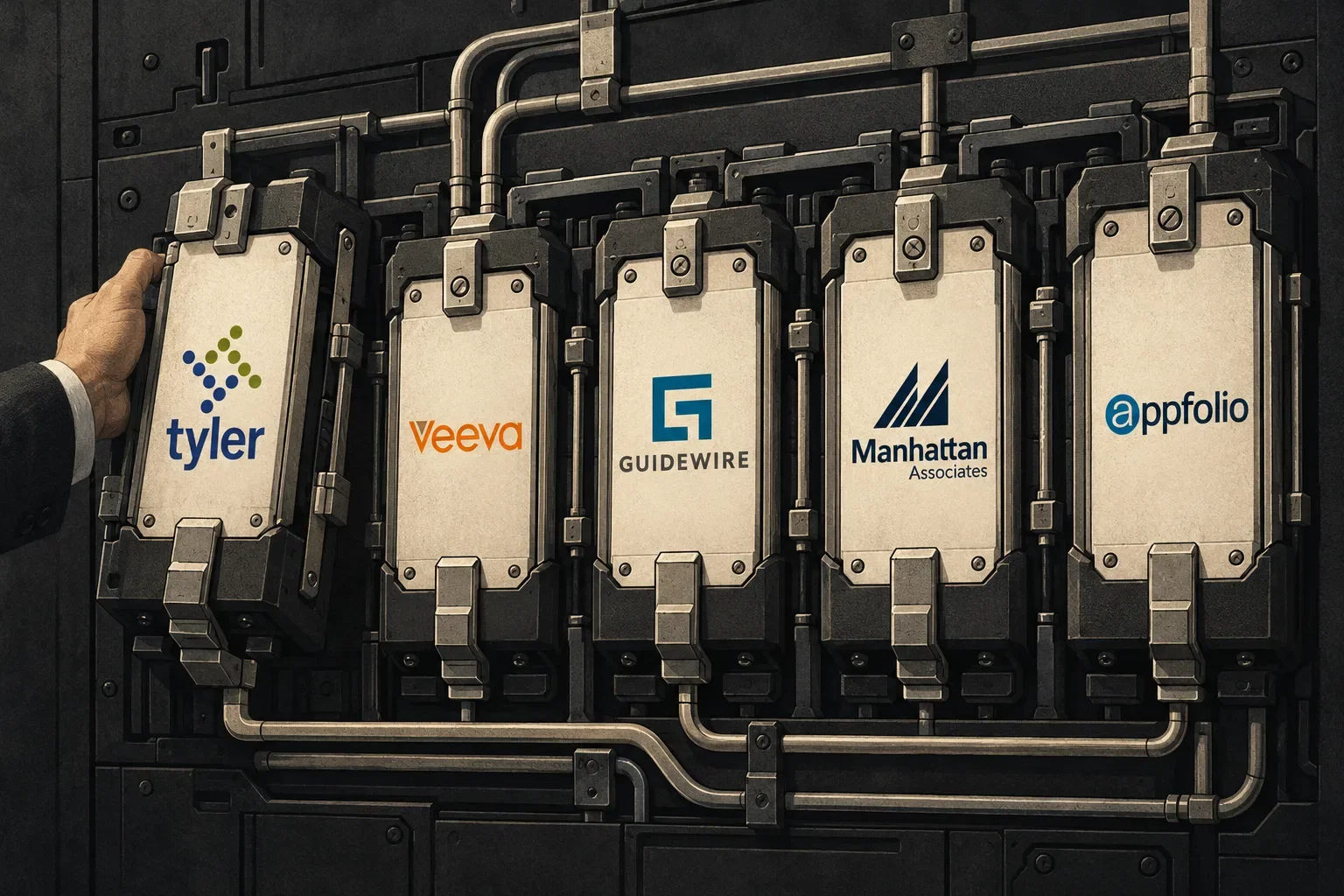
Key points
Software stocks lost roughly 35% between July 2025 and April 2026, as the market made little distinction between easily replaceable tools and mission-critical systems.
The strongest company in this review lost less than 1.5% of its recurring revenue to customer churn over the year, confirming the strength of switching costs.
Recurring cloud and subscription revenue is growing by 14% to 33%, but overall growth is being held back by declines in licenses and maintenance.
Operating cash flow is 1.3 to 2.8 times net income, largely thanks to non-cash stock-based compensation.
For some platforms, transaction services account for as much as 78% of revenue, making them more sensitive to the economic cycle than subscriptions.
In 2026, the software sector underwent one of its sharpest revaluations in the past decade. Concerns that artificial intelligence tools would make enterprise application subscriptions cheaper or replace them altogether have pulled the S&P 500 Software & Services index down by more than a quarter since the start of the year. Software stocks lost roughly 35% between July 2025 and April 2026. The market made little distinction between general-purpose tools that can be replicated and systems underpinning the day-to-day operations of a government agency, insurer or pharmaceutical company.
The five companies in this review belong to the latter group. They provide so-called vertical software: applications designed for a specific industry, its regulations and its particular processes. Their main defense is high switching costs. Replacing a system means migrating data, retraining employees, revalidating it with regulators and risking operational disruption—something a government agency, insurer or warehouse cannot afford during the holiday season.
For each company, four questions matter:
Are customers actually staying, or is high retention merely assumed?
How quickly is recurring revenue growing, and how high-quality is it?
How much does it cost to acquire a new customer, and how much growth comes from the existing customer base?
Is accounting profit turning into cash, and if so, why?
The figures are based on the latest reported results for periods ending in June or July 2026.
How to Read Software Company Metrics
Alongside standard accounting figures, software companies report a range of their own metrics. These are useful, but each company defines them differently, so comparisons require caution.
ARR (annual recurring revenue): For most companies, this is the annual value of active subscription contracts. Some companies, however, calculate ARR simply by multiplying quarterly recurring revenue by four, which also includes variable fees.
RPO (remaining performance obligations): The value of signed contracts that have not yet been recognized as revenue. It works like a backlog and shows how much future revenue is already contractually secured.
Gross churn: The share of recurring revenue lost when customers leave or scale back. The lower it is, the stronger the switching costs.
Adjusted (non-GAAP) metrics: Companies typically exclude employee stock-based compensation and amortization of intangible assets from acquisitions. The gap between adjusted and GAAP accounting profit is large for software companies and indicates how much of their costs are paid in shares rather than cash.
Profit-to-cash conversion: The ratio of operating or free cash flow to net income. A figure above 1 is common in subscription models because customers pay in advance and some costs are non-cash.
Tyler Technologies
Software Powering U.S. Government Agencies
Tyler Technologies $TYL is the largest specialist software provider to U.S. public-sector organizations. It supplies systems for courts, police and emergency services, property tax administration, municipal financial management, school districts and permitting.
Acquiring customers in the public sector is slow and expensive. Procurement processes are formalized, and decisions depend on budget cycles. But once a county or state deploys a system, replacing it is operationally and politically difficult. Citizens, lawyers, banks and other agencies rely on court and tax systems, and any outage would have immediate public consequences.
Recurring Revenue and the Shift to Cloud
In the second quarter of 2026, revenue reached USD 645.1 million, up 8.2% year over year, slightly below analyst estimates of around USD 647 million. Recurring revenue was USD 559.5 million, or 86.7% of the total.
SaaS revenue (software as a service) rose 21.7% to USD 230.6 million. This marked the 22nd consecutive quarter of growth of at least 20%.
Total subscriptions, comprising SaaS and transaction fees, increased 12.0% to USD 453.7 million.
Transaction fees, such as online payments for fines, fees and taxes, grew just 3.5% to USD 223.1 million.
Maintenance fell 5.6% to USD 105.8 million as customers moved from on-premises servers to the cloud.
New SaaS bookings rose 21.1% to a record, but reported revenue lags them by several quarters.
What to Watch in the ARR Metric
Tyler reports ARR of USD 2.24 billion, up 8.2%. However, it calculates ARR by simply multiplying quarterly recurring subscription and maintenance revenue by four. Because Tyler’s subscriptions include transaction fees that depend on payment volumes, this is not a purely contractual figure. It therefore cannot be directly compared with Guidewire’s ARR, which is based on contracts.
Available estimates also suggest that organic growth is roughly 2 percentage points below reported growth, as some growth comes from acquisitions. In the second quarter, Tyler acquired For the Record for USD 213 million.
Profit-to-Cash Conversion
Free cash flow reached USD 118.5 million, up 34.7% year over year, and rose to USD 221.3 million in the first half, from USD 136.2 million a year earlier. Second-quarter GAAP net income was USD 93.5 million, putting cash-to-profit conversion at approximately 1.3×. However, the quality of this figure is diminished by a temporary effect: the company paid roughly USD 30 million less in taxes. Excluding this effect, conversion would be around 1.0×.
Adjusted EBITDA rose just 4.3% to USD 176.4 million, slower than revenue. When operating in the cloud, Tyler bears infrastructure costs instead of the customer, putting pressure on margins during the transition. Management’s 2026 outlook was unchanged: revenue of USD 2.535 billion to USD 2.575 billion, adjusted earnings per share of USD 12.95 to USD 13.20 and a free cash flow margin of 26% to 28%. In June, the company raised its long-term targets through 2030.
Capital Allocation and Valuation
In the second quarter, Tyler spent USD 505 million to repurchase 1.62 million shares and has retired 5.6% of its shares since the start of the year. It also approved a new USD 1.5 billion buyback program. Some of the funds came from a USD 1.4 billion convertible bond issuance in May, and the company had more than USD 1 billion in cash and investments at quarter-end.
Management is taking advantage of the price decline. At the end of July, the stock traded around USD 325, while its 52-week high was above USD 570. Even after the decline, however, it is not a cheap stock: in August, its P/E based on trailing twelve-month earnings was around 44.